

Leadership Under Pressure: Staying Clear, Calm & Decisive

Calmness creates clarity.
Clarity creates action.
Leaders create both.
There’s a moment in every leader’s life when the environment stops playing by the rules. When the plan you walked in with doesn’t match the situation you’re standing in. When people look to you not because you want to lead, but because you must.
Pressure is the great revealer. Not of competence, but of character. Not of titles, but of truth. It strips everything back until only what’s real remains.
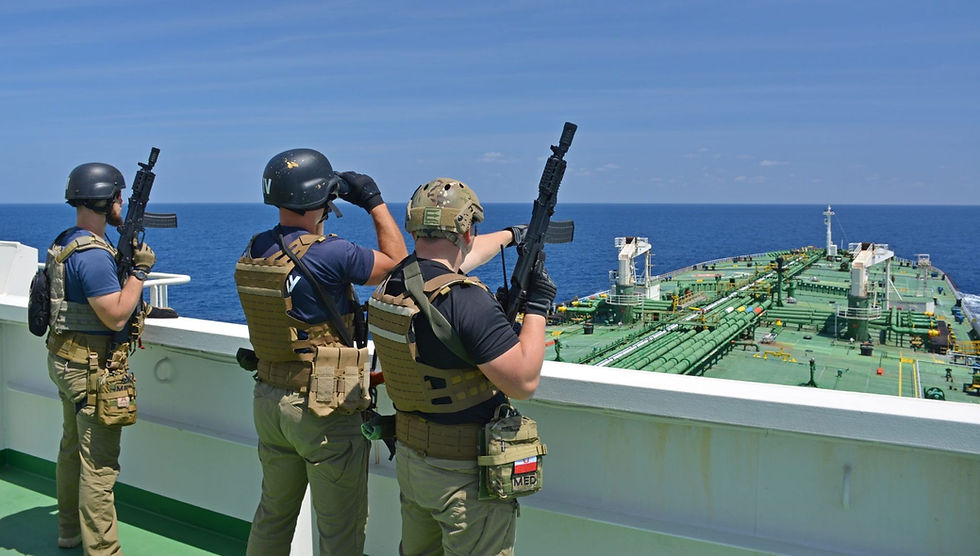
I learned that lesson in the most visceral way possible — standing on the bridge wing of a 330-metre oil tanker off the coast of Somalia.
A Dawn in the High-Risk Area
We’d been in the high-risk area for nearly a week. My team — all former Royal Marines Commandos — had drilled relentlessly before entering the zone. We trusted our skills, our drills, our equipment, and each other. But the ocean doesn’t give warnings, and pressure never announces its arrival politely.
It was just after dawn. The sun sat low on the horizon, a blinding strip of gold that made it almost impossible to see what lay beyond it. I was on the bridge, doing a quiet scan of the water. The ship beneath me — 330 metres long, 50 metres wide, 50 metres high, carrying 25 crew and $300 million worth of cargo — hummed steadily through the swell.
Then, from the glare of the rising sun, three skiffs appeared.
Fast. Direct. Intentional.
And in that split second, the atmosphere on the bridge changed. You could feel the tension sharpen like a blade.
The captain looked at me.
The officer of the watch looked at me.
The lookout looked at me.
My team, waiting for the call, looked at me.
Everyone from the captain to the newest deckhand turned their eyes towards mine.
Leadership isn’t always a speech or a strategy. Sometimes it’s simply the moment when everyone else stops talking and waits to see what you do.
The Duck Syndrome
There’s a saying we used in the Royal Marines — the duck syndrome.
Above the water: calm, smooth, controlled.
Below the water: legs going like hell.
That’s what pressure leadership feels like. On the surface you must project clarity, composure, and belief. Internally, your brain is processing millions of variables: distance, speed, intent, time, risk, escalation, your team’s position, the crew’s safety, the captain’s command, the rules you must follow, and the decisions you must make.
All of that happens in seconds.
And in that moment, on that bridge, I had my own internal battle. Because before I was a Royal Marines Commando, before I was a coach, before I had led security operations across the world — I was a bullied, overweight kid who sat alone in the corner of classrooms. For a heartbeat, that kid surfaced. A flash of doubt. A question of identity.
Pressure does that.
It reaches back into the old versions of you.
Leadership is choosing who answers.
Remember Who You Are
It lasted half a second — but half a second is enough to change everything.
Then training, experience, and identity kicked in. I remembered where I was. Who I was. The team I had built. The drills we had rehearsed. The hundreds of times we had practised exactly this.
I straightened, exhaled, and the calm landed in my body like a weight.
Clarity follows calm.
Action follows clarity.
I issued the first instruction clearly, deliberately, without raising my voice. My team moved instantly. The bridge crew followed our lead. The captain steadied. The lookout reported. The chaos outside became ordered inside.
Pressure didn’t disappear — but leadership took its place.
That’s the point.
You don’t control the storm. You control yourself.
And when you do that, you control the environment around you far more than you realise.
Pressure and the Modern Leader
Most leaders today won’t face armed skiffs off the Horn of Africa.
But they will face:
Sudden market shifts
High-stakes decisions
Team conflict
Performance failures
Impossible deadlines
Organisational overwhelm
Moments where everyone turns to them
Pressure is contextual, but its effects are universal:
Breathing shallows
Thinking narrows
Emotions spike
Decisions slow
Communication becomes clipped
Teams pick up your state instantly
In the C8 Leadership System, we call this Pressure Leadership — the ability to stay clear, composed, and anchored when others get pulled into the uncertainty.
Not because you’re superhuman.
But because you’ve trained yourself to respond, not react.
Calmness Creates Clarity.
Clarity Creates Action.
Leaders Create Both.
Let’s break down what that really means.
Calmness Creates Clarity
When your nervous system settles, your thinking expands. You see options. You interpret information more accurately. You slow the moment down.
Clarity Creates Action
People don’t need perfection from a leader — they need direction. A clear sentence beats a complex plan every time.
Leaders Create Both
Your team regulates off you. If you’re chaotic, they’re chaotic. If you’re centred, they become centred. Your state sets the standard.
The moment on the bridge taught me something simple but profound:
Calm isn’t a personality trait. It’s a trained leadership skill.
How Leaders Build Calm Under Pressure
This isn’t theory — it’s trainable, repeatable behaviour.
Here’s what I’ve seen work across military and high risk security operations, boardrooms, and leadership teams:
1. Control Your Physiology First
In the Royal Marines, under contact (enemy fire), the cardinal rule was 'win the firefight first'. This is because, if you get sucked into eveything else going on (what next, casulties, etc), things would go downhill fast and you'd encounter more problems, more casulties. The same rule applies here: win the firefight against your sympathetic nervous system - fight or flight.
Fast breathing = fast mind.
Slow breathing = slow mind.
Even a single long exhale shifts your brain out of threat mode.
2. Name the Priority, Not the Problem
Under pressure, your brain fixates on everything that could go wrong.
Leadership focuses everyone on what must go right.
3. Use Simple, Clear Language
Pressure reduces cognitive capacity.
Clarity restores it — for everyone.
4. Act on 70% Information
Waiting for perfect clarity creates paralysis.
Progress creates more information than hesitation ever will.
5. Lead from Identity, Not Emotion
Emotion is immediate.
Identity is intentional.
In that moment off Somalia, I didn’t act as the scared kid.
I acted as the leader I had trained to become.
And that changed everything.
Pressure Leadership in Everyday Life
You don’t need an oil tanker or a pirate skiff to experience pressure.
Pressure is:
The moment before a difficult performance conversation
Presenting to the board
Admitting a mistake
Leading a change initiative
Making a decision that affects people’s livelihoods
Having your team look to you when you don’t yet know the answer
The environments change.
The leadership requirement does not.
Final Thought
When people think of leadership under pressure, they imagine boldness, strength, decisiveness.
Those matter — but they’re not the start.
The start is calm.
Calmness creates clarity.Clarity creates action.Leaders create both.
And the truth is this:
You don’t rise to the level of the moment. You fall to the level of your training, your habits, and your self-leadership.
But with deliberate practice, you can raise that level higher than you ever thought possible.
Pressure doesn’t define leaders.
It reveals them — and it can refine them.


Comments